
+96891942114
Contact our office
info@east-gears.com
Contact us via email
he correct Sleeve Bearing for an Excavating Machine depends primarily on three factors: material, exact dimensions, and installation position.
Material options include bronze, bimetal, hardened steel, and self-lubricating composite bushings. Dimensional compatibility requires accurate inner diameter × outer diameter × length measurements and proper matching with the corresponding pin and housing bore. The installation position—such as the bucket linkage, boom, arm, or undercarriage—also determines which bushing design is appropriate.
For high-load, low-speed and oscillating joints, including applications such as boom-to-arm connections and bucket pin assemblies, hardened steel bushings or bimetal bushings with grease grooves can provide an appropriate solution. Where grease access is difficult or equipment operates in dusty mining environments, graphite-plugged self-lubricating or oilless bushings can reduce lubrication requirements.
This guide answers the technical questions buyers commonly ask before introducing the EastGears sleeve bearing product range.
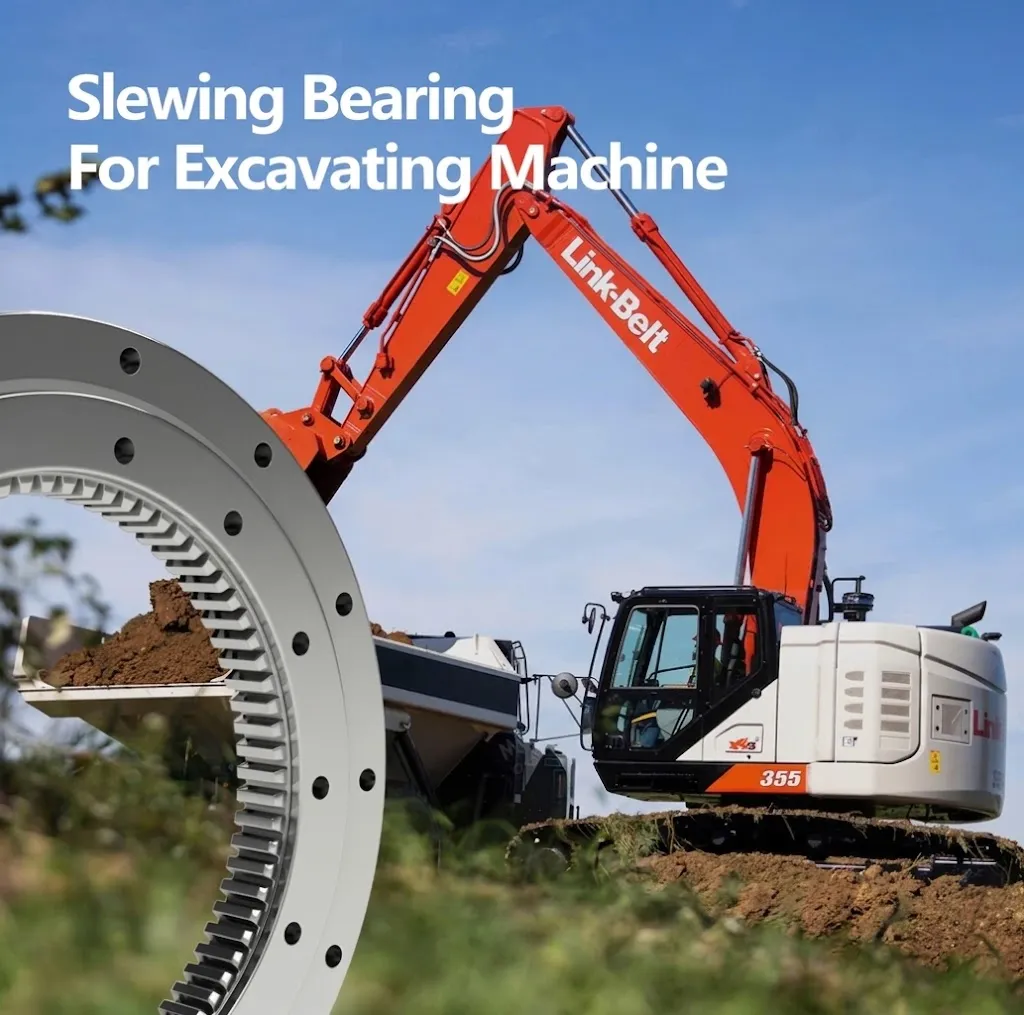
The slewing bearing used by the excavator is a single-row ball slewing bearing, and its teeth are hardened. Its main function is to control the rotation of the upper and lower mechanical arms and other mechanisms, and also to control the rotation of the cabin and the mechanical arms. The motor or reducer drives the small gear to rotate, and the small gear drives the slewing bearing, so that the related mechanism rotates automatically.
The slewing bearing used in the excavator must withstand large axial forces, overturning torque and gear peripheral force, and has higher requirements on the clearance, installation size and material of the slewing bearing.
A Sleeve Bearing, commonly referred to as a Bushing in the heavy-equipment industry, is a cylindrical plain bearing positioned between a pin and the bore of a joint.
Its function is to provide a controlled bearing surface for movement while helping manage friction and wear at machine pivot points.
Unlike rolling bearings such as ball or roller bearings, sleeve bearings do not contain rolling elements. Their compact construction makes them suitable for applications involving high contact loads, low speeds and oscillating motion, which are common operating conditions in excavators and other construction machinery.
In an excavator, the boom, arm, bucket and linkage assemblies operate through repeated articulation and changing loads. The bushing therefore acts as a serviceable bearing component that helps protect more expensive structural components.
Depending on the application and market terminology, the same product category may be described as an Excavator Bushing, Excavator Sleeve Bearing, Sleeve Bushing, Bush Bearing, Plain Bearing or Sliding Bearing.
| Type | Material / Standard | Key Feature | Best Application |
|---|---|---|---|
| Wrapped bronze bushing | CuSn8 / ISO 3547 | Oil pockets, good conformability, economical | Bucket and linkage joints on small-to-mid excavators |
| Bimetal bushing | Steel backing + CuPb10Sn10 lining / SAE 792 | High fatigue resistance, re-machinable after fitting | Hydraulic cylinder ends, alternating-load pivots |
| Hardened steel bushing | 42CrMo or GCr15, hardness HRC 55–62 | Maximum resistance to impact load and abrasive wear | Boom-to-arm joints, boom foot, large pins |
| Oilless (self-lubricating) bushing | Cast bronze with graphite plugs (JDB) | Operates with minimal grease | Hard-to-reach points, dusty mining sites |
| Composite bushing (DU / SF-1) | PTFE layer on steel-bronze backing | Very low friction, smooth articulation | Light-duty pivots, auxiliary attachments |
| Installation Point | Market Name | Load & Motion Type | Maintenance Tip |
|---|---|---|---|
| Bucket and H/I linkages | Bucket pins & bushings | Severe impact load, small-angle oscillation | Daily greasing; check clearance every 1,000 hours |
| Boom-to-arm joint | Boom to arm bushing | High load, axial thrust | Use hardened steel bushing with spiral grease groove |
| Boom foot (to main frame) | Boom foot bushing | Heavy tension-compression forces | Verify bore alignment during replacement |
| Hydraulic cylinder ends | Rod end & case end bushings | Alternating directional load | Dust seals must remain intact |
| Idlers and track rollers | Idler / track roller bushings | Continuous radial load, mud and water contamination | Self-lubricating type recommended |
| Quick coupler interfaces | Quick coupler bushings | High-cycle attachment changes | Inspect clearance at every attachment swap |
1. Measure dimensions and interference precisely. Record inner diameter, outer diameter, and length from the drawing or a used part. Bushings are press-fitted into the bore, and the bore-to-pin pair typically follows an H7/f7 clearance relationship; a 0.1 mm error can halve service life.
2. Estimate load and speed (the PV value). Contact pressure multiplied by sliding velocity defines the bearing’s working limit; for slow oscillation under high pressure, hardened steel and bimetal are the safer choices.
3. Match bushing and pin hardness. The ideal hardness gap between pin and bushing is 5–10 HRC points, ensuring the more expensive pin wears more slowly than the sacrificial bushing.
4. Choose the lubrication pattern. Spiral grooves distribute grease evenly under oscillating motion; cross-hatched (diamond) grooves retain a larger grease reservoir; for hard-to-access points, switch to the self-lubricating type.
5. Take the working environment seriously. In dusty mining sites, intact sealing and protective washers block abrasive particles; in humid or coastal environments, bronze or copper/tin-coated bushings are preferred.
6. Refer to OEM standards and part numbers. Provide your Komatsu, Caterpillar, Hitachi, Doosan/Develon, Hyundai, Volvo, or JCB part number to the supplier so dimensions can be matched exactly to your machine model.
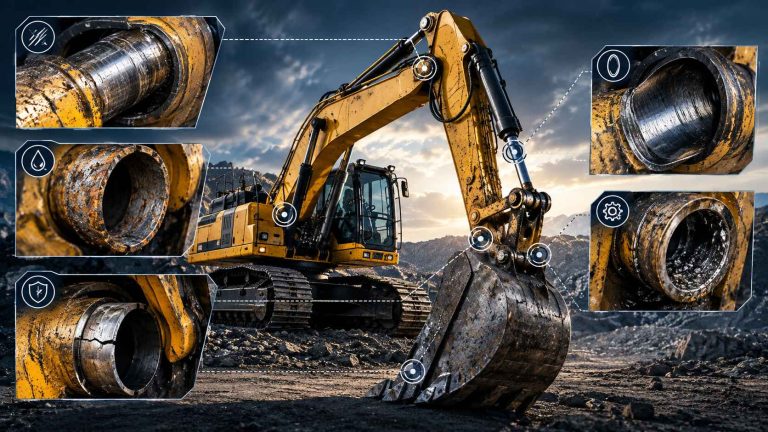
Understanding common failure modes can improve both product selection and maintenance planning.
| Failure Symptom | Possible Cause | Engineering Response |
|---|---|---|
| Scoring on inner surface | Abrasive particle ingress | Inspect dust seals and lubrication |
| Rapid wear | Grease starvation or extended service intervals | Review maintenance plan |
| Fretting corrosion | Incorrect pin/bushing hardness relationship | Use an approved matched pair |
| Pitting / spalling | Impact exceeding material capacity | Consider hardened steel or bimetal |
| Bore ovality | Incorrect press fit or installation | Verify bore and installation procedure |
If an Excavator Replacement Bushing experiences premature wear, replacing the bushing alone may not resolve the underlying issue. The pin, bore, lubrication and sealing condition should also be evaluated.
The service life of an Excavator Bushing depends on operating conditions, lubrication discipline, loading, contamination and maintenance practices.
The EastGears source content states that bucket-joint bushings may typically operate for approximately 1,500 to 4,000 operating hours, depending on working conditions and lubrication.
However, operating hours alone should not determine replacement. Excessive clearance, uneven wear and actual joint condition are more relevant replacement indicators.
The choice between a Bronze Excavator Bushing and a Hardened Steel Bushing depends on the application.
Bronze can provide good conformability and suitable friction characteristics, while hardened steel provides significantly higher resistance for demanding joints exposed to high impact and contact loads.
For heavy-duty pivot points such as boom-to-arm connections, hardened steel may be more appropriate, while bronze or bimetal designs may be better suited to other applications
A Self-Lubricating Bushing can replace a greased bushing in suitable applications when the operating conditions remain within the material’s rated limits.
This solution is particularly valuable for remote or difficult-to-access points where regular grease maintenance is challenging.
Graphite-plugged bronze bushings can therefore be considered for selected slow-oscillating, high-load applications and may reduce maintenance requirements.
EastGears can evaluate a bushing requirement using several types of technical information.
Provide the original part number from Komatsu, Caterpillar or another OEM.
A drawing should ideally include:
ID × OD × Length + Required Tolerances
If a used component is available, a physical sample can be submitted for evaluation and reverse engineering.
According to the supplied EastGears content, common sizes may be available from stock.
For custom dimensions, the stated typical MOQ is 50 pieces, with a typical lead time of 2–4 weeks. The source also states that a dimensional sample is provided before bulk-order confirmation under the company’s policy.
These commercial figures should be confirmed with EastGears before final publication because MOQ and lead times can change according to production capacity and current company policy.
Not necessarily. The condition of the pin should first be evaluated.
If the pin has excessive surface wear, installing a new bushing on the worn pin can create an incorrect contact pattern and significantly reduce the service life of the new bushing.
A professional maintenance assessment should therefore consider:
Pin + Bushing + Bore + Lubrication
as one working system.
According to the supplied EastGears information, the company can also provide hardened pins matched to its bushings where required.
If you are sourcing Sleeve Bearings for Excavating Machines, Excavator Bushings, Excavator Sleeve Bushings, Bucket Bushings, Boom Bushings, Arm Bushings, Linkage Bushings, Pin Bushings or Self-Lubricating Bushings, send your technical requirements to the EastGears team.
For a faster and more accurate quotation, provide:
| Required Information | Purpose |
|---|---|
| OEM Part Number | Product Matching |
| Machine Brand | Machine Identification |
| Machine Model | Compatibility |
| Inner Diameter | Pin Matching |
| Outer Diameter | Bore Matching |
| Length | Dimensional Matching |
| Material | Engineering Selection |
| Lubrication Pattern | Maintenance Compatibility |
| Quantity | Commercial Quotation |
| Drawing / Sample | Custom Manufacturing |
Request a Quote
Send Your Drawing
Request Custom Bushing
Get Free Technical Consultation
According to the supplied EastGears content, customers can submit a part number, drawing or sample to receive a technical response, quotation and delivery schedule.